Wednesday, June 30, 2010

Ambohimahamasina, Part 1: Journey and Arrival (6/20)


So we left for Ambohimahamasina Sunday afternoon, more or less around 2pm (as planned). Packed everything into the back of the rugged Land Rover-esque vehicle. Francesca and I commented that you really don’t realize what a car, or even a taxi-brousse-like van, is capable of until you put it on atrocious uneven, unpaved roads and steep inclines. At first when we got here I had to close my eyes when we drove in certain areas – surely we wouldn’t be able to drive there without tipping over! But now I’m used to it: you have to figure your driven knows what he’s doing, as he’s been getting around just fine his whole life here!
Our driver took us first to his place to pick up his bag, then to Raïssa’s (who is in charge of sanitation projects with Ny Tanintsika) to pick up her and her 9-month-old baby Ephraim, who has a fantastic laugh. Raïssa said she normally wouldn’t bring him to the field, but she’s still in the process of looking for a new nourrice (wet nurse) to look after him.
After picking up Raïssa and Ephraim we stopped for gas at a Jovenna station; I stared straight ahead stoically as the station attendants peered curiously through the windows at my whiter-than-ever face (it’s always so cloudy here! I’m convinced I’ll come back to the US whiter than when I left!). I was riding shotgun, but Raïssa had warned me that this was only temporary; “on sera quatre” (“we will be four”) in the back. I hoped this meant Francesca, me, her, and the baby.
Next we stopped by the Fianar taxi-brousse station to pick up Pierre Louis, a French intern, who got to sit shotgun for the drive because he was “wide,” according to Raïssa – by Malagasy standards, not American, that is! I moved back to the back.
But then we stopped at another gas station to pick up Paul (another NT team member, and Raïssa’s baby’s father, I think), who joined us in the back. Four adults and one baby (who alternated between Raïssa’s and Paul’s laps) – needless to say, a bit of a squeeze! And all without seatbelts (let alone a carseat for the baby), I might add!
The drive was beautiful: hills, mountains, valleys, streams, rice paddies, green with red earth. A flash of a waterfall. Over bridges (the only time the driver ever slowed down! I’m pretty sure there are no road rules here…). As we got father and farther away from Fianar, I felt a sense of elation, the thrill of the road and adventure in the air. The past few weeks of back-and-forth between the house and the office right next to each other had given both Francesca and I a bit of cabin fever; now, it felt so good to be out and seeing new things!
We stopped at a panoramic spot so the men could relieve themselves – alas, again, the limits of female anatomy!
After about an hour’s drive we stopped in Ambalavao, the last major town before our destination (another 1½+ hour’s drive away), for dinner at Chez Mamidà Hotely, a tiny little hole in the wall with three tables and benches. A group of singers was practicing in a back room. Everything on the menu consisted of rice with some sort of meat. Hilarious. Francesca and I were still wary of food we didn’t cook ourselves, so I abstained (remembering my Nutella and peanut butter sandwich waiting for me in the car), while Francesca attempted to order just a bowl of rice.
Just rice? Nothing else? Nothing with it? No, you can’t just order rice. “Just rice” is not on the menu… They actually found Francesca’s request for “just rice” to be stranger than my abstention!
Finally they negotiated something and Francesca got her bowl of plain white rice. The others were served rice with an accompanying bowl of chicken or pork in broth. Raïssa fed baby Ephraim little spoonfuls of brothy rice with little torn up bits of chicken. Bowls of dark brown liquid arrived soon thereafter. Coffee? I wondered. Of course not: it was ranon'ampango, Malagasy rice water, freshly made from boiling water in the rice pot filled with stuck-on burnt rice (in this case, very burnt!).
We were soon back on the road again, and began our climb into the hills as night fell. We passed fewer and fewer small villages, and it became harder to see the scenery. The road was very rough, with deep crevasses in the dirt from where water flowed. The driver tended to try and straddle them with the car, but sometimes we dipped down into them a bit, causing us all to get bumped a bit in the back. Ephraim, once so giggly and well-behaved, began to scream, and kept it up for much of the rest of the drive. Sometimes as we drove I could see people walking along the side of the road, illuminated like ghosts in our headlights. I got lost in my own thoughts, watching the seemingly endless road.
Finally, we arrived in Ambohimahamasina in total darkness. We got out of the car with our backpacks and waited for further instruction. We had no idea where we were staying – none whatsoever. Our boss had kind of left out those details…So we had come prepared for anything – including our own pot to cook in and our own spoons to eat with! I had packed a jar of peanut butter, and was fully mentally prepared to survive on just that if it came down to it!
As seems to be the case with all our adventures here in Madagascar, everything always turns out better than you expect. Romain, a French intern with Ny Tanintsika who’s been here for over a year, came out of one of the buildings – although he had not been expecting us, we, along with Pierre Louis, would be staying chez lui. We climbed up a ladder to the second-floor balcony of a building, walked around to the other side, and entered a small candlelit room (there is only electricity for one hour a day, 6-7pm, in Ambohimahamasina, and no outlets). Inside there was a girl who greeted us in perfect English – I recognized her as Gaia, one of the British med students Ambinina had spoken of. She is Sri Lankan, but grew up in Dubai and was educated in Canada and the UK; she just finished med school and is back in Madagascar for a few more weeks, until mid-July. She and Romain are living here in Ambohimahamasina: Romain working for NT on Projet Pailles, Gaia teaching English to high-schoolers and tour guides, as well as teaching some family planning. Although we were unexpected guests, we were welcomed without hesitation.
Romain began to cook, and although I was still imbued with paranoia induced by too many Princeton Travel Health meetings, I gave in to my hunger. Red rice (particular to the Betsileo region, and a welcome change to boring old white rice; plus it has more nutrients!), des breds (a sort of Chinese leafy green vegetable, served in Madagascar boiled in lots of water to be poured over rice), and a tomato and green pepper sauce that Romain called fritanga, one of his pied-noir (French Algerian, before the Algerian Independence) grandmother’s recipes.
Afterwards, for dessert, dark chocolate and a fresh pineapple, cut in front of us on the table. This pineapple put all other pineapples I’ve eaten in my life to shame – literally, it was as if every other pineapple I’d ever eaten had just been some weak imitation of the fruit we tasted that night. It was succulently sweet, not acidic at all (usually in the States I can only eat a maximum of 3 pieces without killing off the feeling in my tongue), and you could even eat the center (usually too hard to enjoy in pineapples bought in the states). Romain and Gaia get these golden miracles directly from the growers, who live nearby.
Before and during dinner, the five of us (Romain, Gaia, Pierre Louis, Francesca, and I) had one of those wonderful conversations that only occurs when you get together a bunch of young traveler/expats from all over the world. We spoke in both French and English, switching back and forth based on our moods and abilities; everyone was understood. We discussed cultural differences, international politics, education systems, pop culture, everything – all by candlelight in good company over good food. It’s moments like these when you’re reminded that you don’t just travel to see new places: meeting other travelers and foreigners is one of the best parts of traveling, too.
After dinner we washed our faces and brushed our teeth outside on the balcony using buckets of water: two clean water buckets with a small cup to scoop, and a dirty water bucket for soapy water and spitting out toothpaste. I saw nearby where Romain had put dinner’s dirty dishes, which would be washed in the morning, once the sun came up. I came to a stunning realization: you really can manage just fine without running water!
BUT, before going to sleep that night I finally had to face my greatest fear: the squat toilet. Romain’s bathroom is outside and a little ways behind the building. It looks like a small shed with four doors. The two on the right are the toilets for the whole village, while the two on the left are for Romain, and can be opened only by key. One is a shower space (literally, just where you take your bucket when you want to bathe) and the other is the dreaded latrine. There’s a hole in the ground and a place to indicate where to put your feet. Some of you reading this are probably thinking I’m being overdramatic, others are probably sympathizing. In any case, please don’t judge – I had never done this before! There’s something very disconcertingly natural about a squat toilet – like you’re forced to face the fact that, much as we’d like to forget it, we humans are still animals. But alright, it wasn’t so bad. For me, anyways. Francesca, unfortunately, made us all aware of a potential peril of squat toilets, though: she lost one of her shoes down the hole!

Friday, June 25, 2010

So what am I actually doing here?, and Why I went to Ambohimahamasina...

The original assignment given to us by our boss was to read all of Ny Tanintsika’s past project reports and come up with some sort of report evaluating the success of these projects and what the organization could do in the future. Sounds simple enough, right?
Our first two weeks here were spent reading past project reports, and it soon became apparent that this vague report-writing task was not going to work out. First of all, the organization has about 20-30 past projects, each one with 2-4 50-page project reports. These reports are written in detailed and technical French (I’ve learned the necessary vocabulary to talk about mutual health insurance, well-drilling, latrine-building, and basket-weaving), and do a very good job of self-evaluation, discussing in detail difficulties encountered and suggestions for future projects. So why does Ny Tanintsika need two vasa (foreigners), here for only two months, telling them what to do?
We proposed a new idea: we could focus on one of the projects that we had already read about: namely, that of “Projet Paille: La vannerie pour la vie et l’environnement” (“Project Straw: Basket-weaving for life and the environment”).
It’s a project that has created an association of basket-weaving ateliers called Soamiray (SOO-mee-rye). Basket-weaving is a craft practiced by all Malagasy women in rural areas, allowing them to produce household items for their own families as well as for sale in local markets, which allows them to bring in some extra income, especially needed during la période de soudure (the hungry season, which comes right before the harvest). Soamiray organizes some of the best weavers into small ateliers that can take on larger orders and improve the quality of the items produced, hopefully earning higher prices in the market; some items even go to boutiques in Tana and abroad. Ny Tanintsika is working with Soamiray to improve the organization of these small workshops and the quality of their work, as well as improving the quality of life of the weavers and their families, in areas like sanitation (building hygienic latrines, digging wells with uncontaminated water) and healthcare (teaching family planning, starting up some sort of health insurance mutual).
But along the way there have been many bumps in the road. For one thing, these women have been used to weaving in the privacy of their own homes, doing things their own way: now they have to get used to showing up to the atelier on time (when the Malagasy sense of time is decidedly non-Western) and learning the importance of quality norms and using standard measurements to ensure a uniform product. There is difficulty getting people to show up consistently, as sick children, the agricultural calendar and local holidays, and the elaborate funeral traditions of the rural areas can all get in the way. So can jealous husbands, who don’t like their wives traveling to the periodic meetings that the weavers are required to attend. Ny Tanintsika is also trying to get the women to stop using the Pandanus plant as a raw material, as it is a native endangered species. Instead, NT is encouraging the cultivation of alternative materials like vinda and forona, and the use of natural dyes (although they still have to use chemical dyes to produce red and green). The results of NT’s efforts have varied by atelier, but overall the trend is motion in the right direction.
Additionally, there has been cooperation with FIZAM, a local solidarity tourism office, which leads treks through the mountains to these rural villages. Tourists can go to the ateliers, watch the women weave, purchase items, even learn to weave themselves! Each village has a hebergeur who provides simple lodging and traditional meals – a truly one-of-a-kind experience for tourists who want to travel far off the beaten path.
So what do Francesca and I, two American vasa only in Madagascar for two short months, have to offer to NT/Soamiray’s Projet Paille? We can look for new markets for Soamiray’s products; with our French and English language skills and two MacBook computers, we can do a lot of online research and find new places to sell these beautiful woven baskets, hats, and other items, both here in Madagascar (perhaps not just boutiques: how about hotel lobbys? Local tourism offices?), and abroad (France, the UK, and the US). We can find out about the possibility of Soamiray joining a Fair Trade Organization, which could get its products to fair trade/worldshop boutiques abroad (like Ten Thousand Villages in the US). We can get the word out about the solidarity tourism opportunities: make sure English language guidebooks know about the place, maybe contact travel magazines, see if they’d be willing to do a feature. And even if none of these efforts leads to something concrete this summer – there are still internal problems that NT and Soamiray have to deal with – we can leave all this information in a report for NT to use when Soamiray has matured enough and is ready for new opportunities.
We pitched this idea to our new boss Nathalie (Sam has returned to the UK to have her baby), and she liked it. Now, driven by a more focused purpose and a project we are actually excited about, Francesca and I are looking forward to the next month and a half – we feel like we actually have something to contribute, and at the same time we will learn so much!
After accepting our pitch, Nathalie said there was a fast-approaching opportunity for us to go into the field and see Soamiray in action. We would travel to rural Ambohimahamasina (pronounced “ambo-ma-MASH-nah”) with some field agents on Sunday, June 20th and stay there until Thursday. We would talk to the field agents, visit the ateliers, see firsthand what was going on, the things that technical project reports simply can’t communicate to you. We didn’t really have details of where we would be staying or who we would be answering to… But then again, IIP internships are not known for their specificity; come what may, we trust and brace ourselves for whatever lies ahead!

Saturday, June 19, 2010

Variation on a theme of “Patates malgaches”


The other day Charles the office guard (who, by the way, is now guarding during the day; he and the other guard switch off every week who guards at night and who guards during the day) said he had some “patates malgaches” for us to buy, since we had liked the first ones he brought us so much (see earlier post about “patates malgaches” and manioc). We bought a bag of them from him, uncooked. While the first ones we tried had been purple on the outside (although Charles called them “les rouges”, whitish on the inside, these were “les jaunes,” pale brown on the outside, yellow on the inside.
Hungry, we went back to our house and immediately cooked them for lunch. Or rather, I washed them in chlorine, then cooked them for lunch. Sure enough, they tasted just like “les rouges” – that is to say, delicious.
Francesca has been frying regular potatoes lately, which we bought last week, in addition to plantains, so when she went to do it again the other night, I proposed we try to fry the sweet “patates malgaches” in the hopes of achieving something like a sweet potato fry. Never having fried anything in my life (no pot of boiling oil has ever been seen in the Shaw-Champion home in my twenty years of life!), I left this to Francesca. She peeled and sliced them (uncooked) with some difficulty – they seem harder and tougher than regular potatoes, very fibrous at the ends. But they fry up just fine – yum!

Friday, June 18, 2010

The Kids! : Malagasy Children


Malagasy children are adorable. There is no denying it. They’re everywhere and they just are.
~
In Tana (the capitol) there were a lot of children begging, and heartbreaking as it might be, you had to say no – you don’t want to teach children to expect handouts from every foreign-looking person they see.
Here in Fianar, things are better. The children either go to Malagasy schools where they learn some French, or French schools (taught entirely in that language). The French school kids wear little blue smocks over their clothes, and you see them coming home from school in the afternoons for lunch (remember: 2-hour lunch breaks for all!). Some are fascinated by our appearances (not only are we non-Malagasy, but we are also taller than the average man here!); some like to show off their knowledge of English by saying “Hello!” with a big grin.
~
Two children, cousins, live next door to us and are always playing in our yard. Antonio is eleven, very tall and skinny, and speaks good French. He told me he studies everything in school: French, English, German, science, technology, math. He likes it all. I asked him to teach me some Malagasy, pointing at things around the yard: “leaf,” “rock,” “flower,” “dog.” Every word had so many syllables! The only one I retained was something like “AH-la”: spider.
Enola is eight and adorable, with short black curls; she sets out her dolls and bears in the yard and “cooks” food for them and her scruffy little white dog, Pitou. She loves hiding calling my name and waiting for me to look around the yard for her.
A few days into our friendship with the kids, things got a little out of hand. Antonio and Enola and friends decided it was great fun to bang incessantly on the door of our house and yell until we came to see who it was, then run away. And repeat. And when we caught on and started ignoring them, undeterred, they climbed through the bushes in front of our kitchen window and starting making faces at us thee. Francesca had to go out and yell at them twice, threatening to tell their mother. Things got a lot quieter after that! Shy and ashamed, it took a few days of our friendly hellos to get them to smile again.
~
But on the whole, the children here are very well behaved. I’m especially impressed with Charles (one of the office guards) and his wife’s four daughters [see picture]. The day I brought Charles’ wife my laundry, they were all there, taking care of each other as their mother did laundry and cleaned the office (using a bristly brush that she puts her foot on top of to scrub the floors in a sort of dance!). The baby (8 months old) was splashing water in a plastic tub and laughing. Nearby the oldest (probably around age twelve) was helping the second youngest (age four?) comb and braid her hair; the second oldest (age eight?) was busy on her own hair. I said “Bonjour” and they smiled shyly. I came back later with my camera to take pictures of my laundry hanging from the office’s second floor, and asked their mother if it was alright to take a few pictures of the girls. The second oldest was bold, smiling wide, and moving the shy second-youngest to pose as she sucked on her fingers warily. But when I showed them the first few pictures I had taken, something about seeing their own faces on the little screen broke the ice. Smiles all around! The oldest held the baby and all of them smiled. The second-oldest grabbed her jump-rope and started skipping, everyone started laughing. “Sautez, sautez, tout le monde saute!” (“Jump, jump, everybody jump!”) I said as I jumped too, which produced this shot [see above, click to enlarge], my favorite of the day. Their mother came downstairs to the yard, and I was able to take a family picture of mother and daughters; I promised to send them copies when I got back to the US.
~
I did, however, see something the other day that made me really sad. As we shopped in the market, I saw a little boy, probably around eight or nine, hand some money to a vendor in exchange for two cigarettes. Cigarette consumption by minors in Africa is not a total shocker to me – last summer in France I read an article in Time magazine about how the next big market for tobacco is Africa, where cigarettes are taken out of the package and sold individually. This means that buyers don’t get a chance to read the warning label on the package – that is, if they could read in the first place. Granted, this child could have been buying for a parent, but the just the fact that he could buy, as easily as a piece of candy, something so dangerous (not to mention wasteful – such a terrible way to spend money, especially if you’re already one of the poorest of the poor) was harrowing. As is the fact that Big Tobacco is aware of this growing market (growing literally – as birthrates are high in developing countries) and plans to profit off of lack of education in these countries – well, that’s downright disgusting.
~
But what’s impressed me the most about the children here in Madagascar is how little they need to be happy. No fancy toys, no GameBoy or PlayStation or Nintendo, none of the latest Barbie and Bratz dolls, no computers or cell phones. All they need is a doll or stuffed animal, a few tiny plates and spoons, or a soccer ball, and each other to keep themselves entertained for hours. It’s childhood from a simpler time. Granted, they won’t have the same amazing educational resources that American and European children have; many won’t ever leave the town they were born in, most won’t get to reach their full potential. But for now, they remind me of the value of the simple things: that we don’t always need technology, that sometimes ignorance is bliss, that a few well-loved toys, a friend or sibling and our families really can be enough.

Tuesday, June 15, 2010

More Malagasy Cuisine: “Patates malgaches” et manioc


We’ve been teaching after-hours English lessons to Charles, one of the office guards, and his wife every night when we stop by to use the internet after dinner. To thank us, the couple has taken it upon themselves to resolve the mystery of the unidentifiable root vegetables I’ve been seeing at the market. On Sunday Charles showed up on our doorstep with a steaming plate of what looked like long whole purple yams. He called them “patates malgaches.” Francesca immediately got very excited; she recognized them as what she grew up with in Haiti, calling them “Haitian yams.” Sure enough, despite their color they tasted like the sweet brown-skinned yellowy-orange yams – the candied ones of American Thanksgiving with marshmellow topping – that I knew.
Yesterday (Monday) around lunchtime Charles was back again, this time with a bowl of long, pale, stringy-looking starchy vegetables, which he called “manioc” [see picture, double-click on enlarge]. I was familiar with the name, and we gratefully accepted his offering. Manioc proved to be rather bland, but piping hot they were satisfying and filling. Last night while on the phone with Robin he pointed out that I had already tried manioc – it’s what Cubans call “yuca,” and we had had it in March at “Cuba” restaurant in New York City. Then, it had been fried in oil and flavored with garlic, so I hadn’t recognized it here in Madagascar! Upon further research, it seems that certain crops are quite popular across the globe in tropical and/or island nations, with manioc/yuca being a prime example!

Monday, June 14, 2010

Market Day in Fianar!


While you can’t walk 15 feet without running into something being sold on the street here, Tuesdays and Fridays are the big market days in Fianarantsoa. Ambinina, a Malagasy sociology student and intern at Ny Tanintsika, had offered to accompany us to this Friday’s market to help us and prevent us from getting ripped off or just generally confused. Prices are not listed, and the people selling produce often don’t speak much French and sometimes give prices in francs, which haven’t been in use since 2003, when the ariary was adopted [for reference, it’s about 1,800 ariary to the dollar, so as Americans we feel like big spenders here!]. Ambinina explained that to get the price in ariary you have to divide by 5; for example, something that costs 5,000 francs is really 1,000 ariary. And yet sometimes when you ask for a price, vendors will give you an outrageous number, assuming you know they’re talking about francs and not ariary! This explains a lot of our confusion at Tuesday’s market, before we had this information!
Friday was foggy and overcast, with intermittent drizzles; this may be the “dry season” in Madagascar, but it’s still wet and cold! I wore a sweatshirt AND a fleece jacket, along with jeans and my boyfriend’s winter socks. Not exactly your mental image of a perfect market day!
We climbed the hill, past the extensive area where secondhand clothes are sold on the street, to the top where produce and other foods are sold. Things familiar: tomatoes (1,200 ariary/kilo), lettuce, eggplant (1,600 ariary/kilo), zucchini, carrots (big fat orange ones, stalks still attached), green beans (haricots verts!), onions (2,000 ariary/kilo), garlic, potatoes, oranges (actually quite yellow), lemons (citron, very round and small), tangerines (1,000 ariary/kilo), herbs (rosemary and thyme), eggs (320 ariary/each). Things less familiar: live turkeys, ducks, and chickens lined up in neat rows right on the walkway, you’d think they’d peck at your ankles, their legs tied together with rope; cuts of meat hanging unrefrigerated and uncovered, flies buzzing around; ground manioc leaf (mounds of green paste; Ambinina said Malagasies eat it with pork); mysterious-looking root vegetables; dark wild honey sold out of old plastic Coca-cola bottles; tall piles of shrimp sitting out unchilled. And best of all: what I thought were little brown crayfish…which turned out to be grasshoppers! Ambinina said that this year there had been an infestation of them in one part of the country, but no matter – Malagasies eat them! This was especially funny to me, having just read a New York Times article that morning about how a massive grasshopper invasion in the US Midwest had called for one of the largest assemblies of insecticide-spraying planes to be deployed (see article: http://www.nytimes.com/2010/06/10/us/10grasshopper.html?scp=1&sq=grasshoppers&st=cse). Now if only Americans would eat grasshoppers, this wouldn’t be a problem: no one would go hungry, AND we could spare the already-compromised environment the extra pesticides! It was one of those clear Western-world-versus-developing-world moments for me: when life gives Americans grasshoppers, they bring out the big guns, but when life gives Malagasies grasshoppers, they make snacks!
In addition to produce, we also decided to buy that other staple of the Malagasy diet (besides rice): beans. We found a man chatting on his cell phone selling them out of sacks: white beans, red beans, peanuts. Things like rice and beans bought at the open market and coconut oil (which is sold out of giant vats, used for cooking and for haircare) are bought with the Malagasy unit of measure called the kapoka. It’s a little metal cup that looks a lot like a tin can peeled of its label. We bought two kapoka of marbled red beans for 500 ariary/kapoka [see picture].
As we walked home, bags full of produce, we passed more people selling fruit and vegetables along the road, Francesca (who is Haitian) got really excited: one woman was selling not bananas, but plantains! That night we had an almost-authentic (Francesca wasn’t fully satisfied with the rice and beans, although I had no complaints!) Haitian dinner of rice and red beans and fried plantains. Yum!

Sunday, June 13, 2010

Laundry time, Malagasy style!


It's been almost two weeks since I left the US, and I was in dire need of shirts (remember, if you will, that we weren't showering for the first few days). Our boss had told us that we could pay the office guard's wife, who also cleans the office, to do our laundry.
Laundry is hand-washed outdoors here in big plastic tubs, and hung to dry on clotheslines, railings, fences, walls - even bushes or on the ground! I knew coming here that my clothes might not fare well with this treatment of hand-scrubbing and sun-bleaching, so I purposely only brought free Princeton T-shirts and cheap (and sometimes rather ugly) items I bought at Target (new jeans, bras, and underwear) with the thought that I could leave them all behind and fill my suitcase with souvenirs when I returned to the US in August.
This morning I passed off my bulging plastic bag of clothes to the guard to give to his wife, and waited to see what would happen.
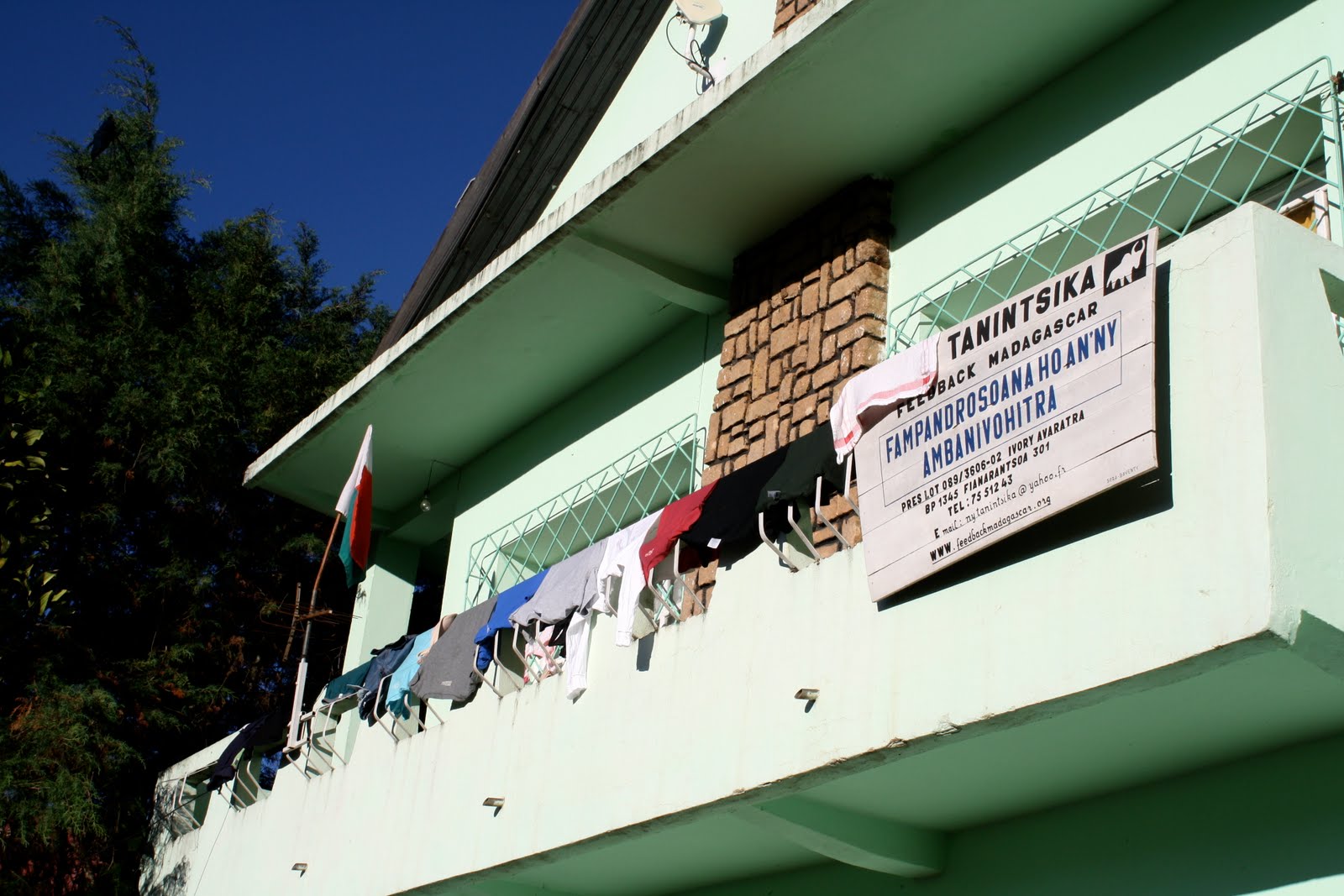
Later in the afternoon, I stopped by the office to use the internet. I looked up only to find all of my clothes hanging out the office's second-floor windows! [see picture, click for larger view]
Nevertheless, all my clothes were returned to me, most of them dry (the socks and jeans were still a little wet), but everything was clean and fresh, and even the stains were gone!