Showing posts with label daily life. Show all posts

Friday, June 18, 2010

The Kids! : Malagasy Children


Malagasy children are adorable. There is no denying it. They’re everywhere and they just are.
~
In Tana (the capitol) there were a lot of children begging, and heartbreaking as it might be, you had to say no – you don’t want to teach children to expect handouts from every foreign-looking person they see.
Here in Fianar, things are better. The children either go to Malagasy schools where they learn some French, or French schools (taught entirely in that language). The French school kids wear little blue smocks over their clothes, and you see them coming home from school in the afternoons for lunch (remember: 2-hour lunch breaks for all!). Some are fascinated by our appearances (not only are we non-Malagasy, but we are also taller than the average man here!); some like to show off their knowledge of English by saying “Hello!” with a big grin.
~
Two children, cousins, live next door to us and are always playing in our yard. Antonio is eleven, very tall and skinny, and speaks good French. He told me he studies everything in school: French, English, German, science, technology, math. He likes it all. I asked him to teach me some Malagasy, pointing at things around the yard: “leaf,” “rock,” “flower,” “dog.” Every word had so many syllables! The only one I retained was something like “AH-la”: spider.
Enola is eight and adorable, with short black curls; she sets out her dolls and bears in the yard and “cooks” food for them and her scruffy little white dog, Pitou. She loves hiding calling my name and waiting for me to look around the yard for her.
A few days into our friendship with the kids, things got a little out of hand. Antonio and Enola and friends decided it was great fun to bang incessantly on the door of our house and yell until we came to see who it was, then run away. And repeat. And when we caught on and started ignoring them, undeterred, they climbed through the bushes in front of our kitchen window and starting making faces at us thee. Francesca had to go out and yell at them twice, threatening to tell their mother. Things got a lot quieter after that! Shy and ashamed, it took a few days of our friendly hellos to get them to smile again.
~
But on the whole, the children here are very well behaved. I’m especially impressed with Charles (one of the office guards) and his wife’s four daughters [see picture]. The day I brought Charles’ wife my laundry, they were all there, taking care of each other as their mother did laundry and cleaned the office (using a bristly brush that she puts her foot on top of to scrub the floors in a sort of dance!). The baby (8 months old) was splashing water in a plastic tub and laughing. Nearby the oldest (probably around age twelve) was helping the second youngest (age four?) comb and braid her hair; the second oldest (age eight?) was busy on her own hair. I said “Bonjour” and they smiled shyly. I came back later with my camera to take pictures of my laundry hanging from the office’s second floor, and asked their mother if it was alright to take a few pictures of the girls. The second oldest was bold, smiling wide, and moving the shy second-youngest to pose as she sucked on her fingers warily. But when I showed them the first few pictures I had taken, something about seeing their own faces on the little screen broke the ice. Smiles all around! The oldest held the baby and all of them smiled. The second-oldest grabbed her jump-rope and started skipping, everyone started laughing. “Sautez, sautez, tout le monde saute!” (“Jump, jump, everybody jump!”) I said as I jumped too, which produced this shot [see above, click to enlarge], my favorite of the day. Their mother came downstairs to the yard, and I was able to take a family picture of mother and daughters; I promised to send them copies when I got back to the US.
~
I did, however, see something the other day that made me really sad. As we shopped in the market, I saw a little boy, probably around eight or nine, hand some money to a vendor in exchange for two cigarettes. Cigarette consumption by minors in Africa is not a total shocker to me – last summer in France I read an article in Time magazine about how the next big market for tobacco is Africa, where cigarettes are taken out of the package and sold individually. This means that buyers don’t get a chance to read the warning label on the package – that is, if they could read in the first place. Granted, this child could have been buying for a parent, but the just the fact that he could buy, as easily as a piece of candy, something so dangerous (not to mention wasteful – such a terrible way to spend money, especially if you’re already one of the poorest of the poor) was harrowing. As is the fact that Big Tobacco is aware of this growing market (growing literally – as birthrates are high in developing countries) and plans to profit off of lack of education in these countries – well, that’s downright disgusting.
~
But what’s impressed me the most about the children here in Madagascar is how little they need to be happy. No fancy toys, no GameBoy or PlayStation or Nintendo, none of the latest Barbie and Bratz dolls, no computers or cell phones. All they need is a doll or stuffed animal, a few tiny plates and spoons, or a soccer ball, and each other to keep themselves entertained for hours. It’s childhood from a simpler time. Granted, they won’t have the same amazing educational resources that American and European children have; many won’t ever leave the town they were born in, most won’t get to reach their full potential. But for now, they remind me of the value of the simple things: that we don’t always need technology, that sometimes ignorance is bliss, that a few well-loved toys, a friend or sibling and our families really can be enough.

Monday, June 14, 2010

Market Day in Fianar!


While you can’t walk 15 feet without running into something being sold on the street here, Tuesdays and Fridays are the big market days in Fianarantsoa. Ambinina, a Malagasy sociology student and intern at Ny Tanintsika, had offered to accompany us to this Friday’s market to help us and prevent us from getting ripped off or just generally confused. Prices are not listed, and the people selling produce often don’t speak much French and sometimes give prices in francs, which haven’t been in use since 2003, when the ariary was adopted [for reference, it’s about 1,800 ariary to the dollar, so as Americans we feel like big spenders here!]. Ambinina explained that to get the price in ariary you have to divide by 5; for example, something that costs 5,000 francs is really 1,000 ariary. And yet sometimes when you ask for a price, vendors will give you an outrageous number, assuming you know they’re talking about francs and not ariary! This explains a lot of our confusion at Tuesday’s market, before we had this information!
Friday was foggy and overcast, with intermittent drizzles; this may be the “dry season” in Madagascar, but it’s still wet and cold! I wore a sweatshirt AND a fleece jacket, along with jeans and my boyfriend’s winter socks. Not exactly your mental image of a perfect market day!
We climbed the hill, past the extensive area where secondhand clothes are sold on the street, to the top where produce and other foods are sold. Things familiar: tomatoes (1,200 ariary/kilo), lettuce, eggplant (1,600 ariary/kilo), zucchini, carrots (big fat orange ones, stalks still attached), green beans (haricots verts!), onions (2,000 ariary/kilo), garlic, potatoes, oranges (actually quite yellow), lemons (citron, very round and small), tangerines (1,000 ariary/kilo), herbs (rosemary and thyme), eggs (320 ariary/each). Things less familiar: live turkeys, ducks, and chickens lined up in neat rows right on the walkway, you’d think they’d peck at your ankles, their legs tied together with rope; cuts of meat hanging unrefrigerated and uncovered, flies buzzing around; ground manioc leaf (mounds of green paste; Ambinina said Malagasies eat it with pork); mysterious-looking root vegetables; dark wild honey sold out of old plastic Coca-cola bottles; tall piles of shrimp sitting out unchilled. And best of all: what I thought were little brown crayfish…which turned out to be grasshoppers! Ambinina said that this year there had been an infestation of them in one part of the country, but no matter – Malagasies eat them! This was especially funny to me, having just read a New York Times article that morning about how a massive grasshopper invasion in the US Midwest had called for one of the largest assemblies of insecticide-spraying planes to be deployed (see article: http://www.nytimes.com/2010/06/10/us/10grasshopper.html?scp=1&sq=grasshoppers&st=cse). Now if only Americans would eat grasshoppers, this wouldn’t be a problem: no one would go hungry, AND we could spare the already-compromised environment the extra pesticides! It was one of those clear Western-world-versus-developing-world moments for me: when life gives Americans grasshoppers, they bring out the big guns, but when life gives Malagasies grasshoppers, they make snacks!
In addition to produce, we also decided to buy that other staple of the Malagasy diet (besides rice): beans. We found a man chatting on his cell phone selling them out of sacks: white beans, red beans, peanuts. Things like rice and beans bought at the open market and coconut oil (which is sold out of giant vats, used for cooking and for haircare) are bought with the Malagasy unit of measure called the kapoka. It’s a little metal cup that looks a lot like a tin can peeled of its label. We bought two kapoka of marbled red beans for 500 ariary/kapoka [see picture].
As we walked home, bags full of produce, we passed more people selling fruit and vegetables along the road, Francesca (who is Haitian) got really excited: one woman was selling not bananas, but plantains! That night we had an almost-authentic (Francesca wasn’t fully satisfied with the rice and beans, although I had no complaints!) Haitian dinner of rice and red beans and fried plantains. Yum!

Sunday, June 13, 2010

Laundry time, Malagasy style!


It's been almost two weeks since I left the US, and I was in dire need of shirts (remember, if you will, that we weren't showering for the first few days). Our boss had told us that we could pay the office guard's wife, who also cleans the office, to do our laundry.
Laundry is hand-washed outdoors here in big plastic tubs, and hung to dry on clotheslines, railings, fences, walls - even bushes or on the ground! I knew coming here that my clothes might not fare well with this treatment of hand-scrubbing and sun-bleaching, so I purposely only brought free Princeton T-shirts and cheap (and sometimes rather ugly) items I bought at Target (new jeans, bras, and underwear) with the thought that I could leave them all behind and fill my suitcase with souvenirs when I returned to the US in August.
This morning I passed off my bulging plastic bag of clothes to the guard to give to his wife, and waited to see what would happen.
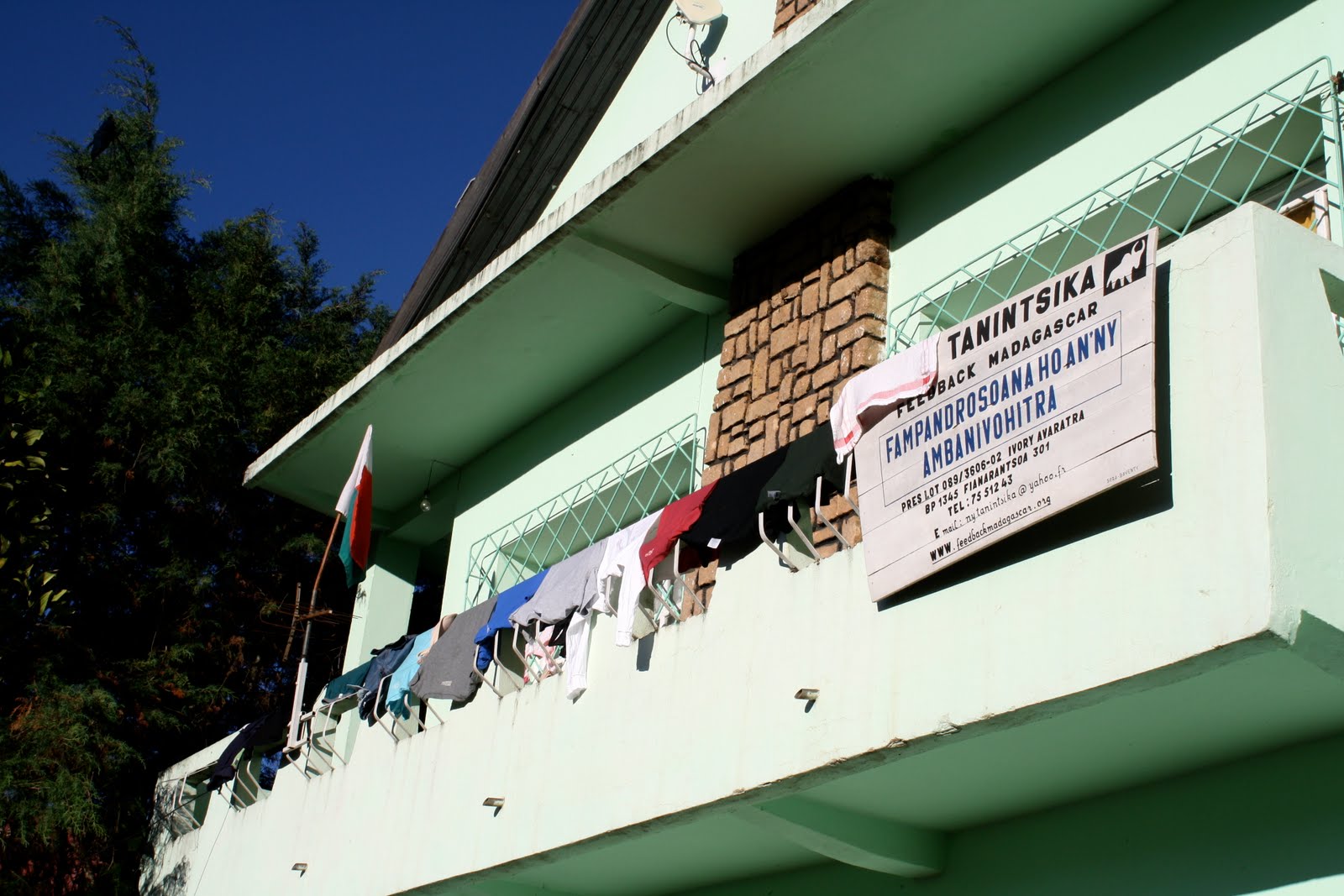
Later in the afternoon, I stopped by the office to use the internet. I looked up only to find all of my clothes hanging out the office's second-floor windows! [see picture, click for larger view]
Nevertheless, all my clothes were returned to me, most of them dry (the socks and jeans were still a little wet), but everything was clean and fresh, and even the stains were gone!